Political meme coins are useful case studies because they combine celebrity-scale attention with unusually intense public scrutiny.
$LIBRA: liquidity withdrawal as a structural risk
Reuters reported that blockchain analytics firm Chainalysis identified roughly $99 million in crypto withdrawn from $LIBRA liquidity by eight wallets linked to the token creator. The token surged after Argentine President Javier Milei promoted it and then collapsed. Investigations followed. A launch advisor, Hayden Davis, denied personal profiteering and described the project as a failed plan rather than a scam.
The distinction matters. StonkBuilder should not use “rug pull” as a shortcut when the factual record is disputed. The better language is: creator-linked liquidity withdrawals coincided with a rapid market collapse, according to blockchain analytics reported by Reuters.
The design lesson is even more important: who can remove liquidity, under what rules, and with what public notice?
$TRUMP: fee extraction can succeed while traders lose
Reuters reported that entities behind $TRUMP accumulated an estimated $86 million to $100 million in trading fees in less than two weeks. It also reported that roughly 200,000 wallets—mostly smaller traders—had lost money during the period analyzed.
This does not establish fraud. It exposes a tokenomics question every community project must answer: Is the issuer economically rewarded by speculative churn even when community participants lose?
If yes, the system contains a misalignment.
Better fee design
A community-first token can route a disclosed portion of protocol or LP revenue toward transparent community uses rather than maximizing private extraction. Examples include creator-funded events, grants, community content bounties, security budgets, or long-term ecosystem development.
The crucial elements are disclosure and predictability. Community members should know where fees go before they trade.
Liquidity governance questions
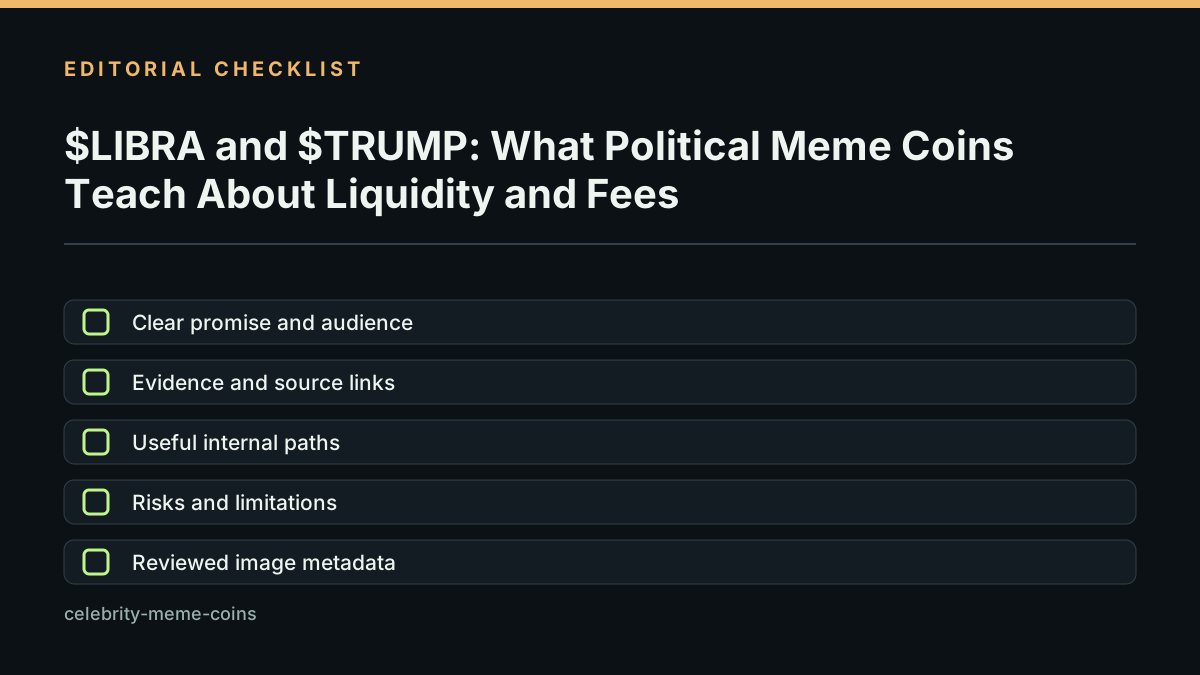
Before launch, publish answers to:
- Who owns LP positions?
- Can liquidity be withdrawn?
- Is it locked, burned, programmatically constrained, or multisig-controlled?
- Who receives trading fees?
- Is there a treasury?
- Who controls treasury keys?
- Are wallets labeled publicly?
- Is there an emergency policy?
A brand-safe principle
If a project cannot explain its liquidity architecture in one diagram, it is too complicated for a celebrity audience.
Read the liquidity design guide →
Read the broader failure analysis →
Sources
- Reuters, $LIBRA: https://www.reuters.com/world/americas/crypto-worth-99-million-withdrawn-milei-backed-libra-token-researchers-say-2025-02-20/
- Reuters, $TRUMP: https://www.reuters.com/markets/currencies/trumps-meme-coin-made-nearly-100-million-trading-fees-small-traders-lost-money-2025-02-03/
---
Educational analysis only. Token structures and legal classifications depend on facts and jurisdiction. Nothing on this page is investment, legal, tax, or regulatory advice.
Continue the launch review
Build a community coin, not an exit-liquidity event.
Design transparent distribution, liquidity guardrails, disclosures, community operations, and long-term brand alignment with StonkBuilder.
Design My Launch