The internet often uses one word—“rug”—for every token that collapses. That is imprecise. A price crash can come from thin liquidity, concentrated ownership, insider selling, fee extraction, broken expectations, speculative mania, poor market-making, or intentional fraud. The right way to analyze a launch is to separate what can be proven on-chain or in court records from what is merely alleged.
Pattern 1: huge headline valuation, tiny effective float
A token can reach a massive market capitalization even when only a small amount of supply is circulating. That creates the illusion of deep value while making the market fragile. When holders try to exit, the liquidity available to absorb sales may be far smaller than the headline valuation suggests.
This issue appears repeatedly in public complaints and on-chain analyses of high-profile launches. In pending $HAWK litigation, plaintiffs allege an unusually thin public float and insider allocations; those remain allegations unless established by the court.
Pattern 2: liquidity can become the product
In healthy markets, liquidity exists to support the product. In extraction-oriented launches, the product can become the trading activity itself. The more fans trade, the more fees creators or liquidity providers may collect.
Reuters estimated that entities behind $TRUMP earned roughly $86 million to $100 million in trading fees in less than two weeks. The same report found that many smaller traders lost money. That does not by itself prove fraud. It demonstrates a structural conflict worth discussing: the issuer-side economics can be positive even while buyers suffer losses.
Pattern 3: creator-linked wallets can withdraw value before the community stabilizes
Reuters reported that around $99 million in crypto was withdrawn from $LIBRA liquidity pools by eight wallets that blockchain analytics firm Chainalysis linked to the token creator. The token surged after Argentine President Javier Milei promoted it and then collapsed. A federal investigation followed.
This is the most direct example in this cluster of why liquidity architecture, wallet labeling, vesting, and withdrawal rules matter.
Pattern 4: celebrity attention creates first-time buyers
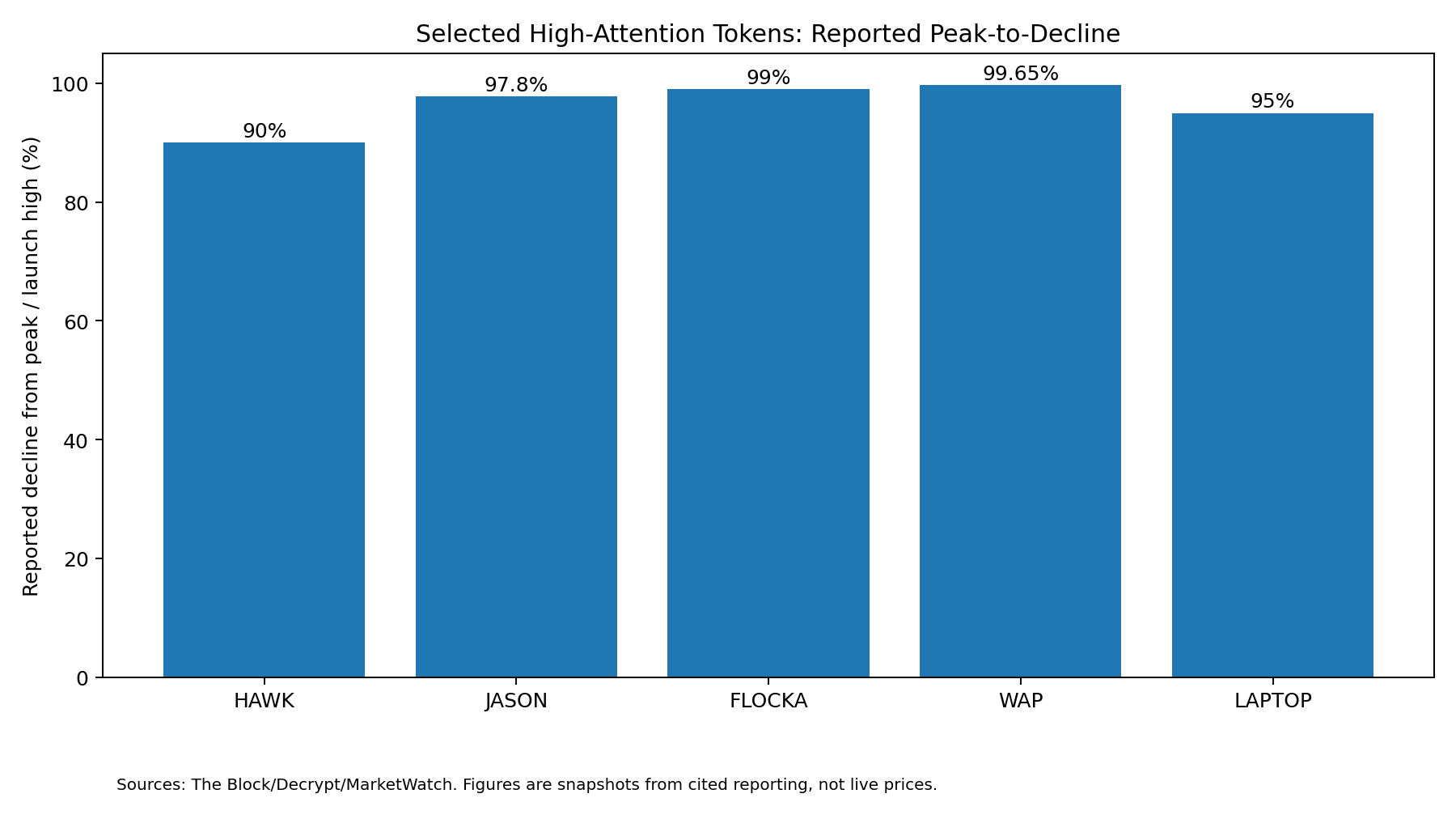
Celebrity audiences contain people who would never normally trade crypto. The $HAWK complaint alleged that many buyers were first-time crypto participants drawn by Haliey Welch’s involvement. The token rose sharply and then fell by more than 90% shortly after launch, according to reporting by The Block. Litigation is pending; allegations should be described as allegations.
The reputational risk is obvious: a fan who loses money does not distinguish between the token developer, launch partner, market maker, liquidity provider, and public face. They remember the celebrity.
Pattern 5: rapid creator selling destroys the social contract
Cointelegraph reported that Nigerian artist Davido acquired a large token position and later sold it for roughly $500,000 after the launch. The publication described strong backlash after the token’s decline. Again, a sale is not automatically illegal—but a community will often interpret fast creator monetization as evidence that insiders had a different objective from fans.
Pattern 6: outsourced launches create accountability gaps
Caitlyn Jenner and Jason Derulo publicly blamed promoter Sahil Arora for problems around their token launches. Jenner later became a defendant in securities litigation concerning $JENNER; Stanford’s Securities Class Action Clearinghouse lists that litigation as ongoing in its last reviewed status. Decrypt reported JASON down 97.8% from its peak by the end of 2024.
The lesson for creators is not “never use agencies.” It is: never outsource fiduciary-level launch decisions without independently understanding allocations, wallets, liquidity, contracts, and incentives.
Pattern 7: promotions can trigger regulatory exposure
The clearest historical example is EthereumMax. In 2022, the SEC charged Kim Kardashian for promoting EMAX without disclosing the amount she had been paid. She agreed to pay $1.26 million in penalties, disgorgement, and interest.
This is not the same as a meme coin launch failure. It is a critical reminder that creator promotion can create legal obligations separate from the token’s technical design.
Pattern 8: the celebrity disappears after launch
Communities can survive volatility. They rarely survive abandonment. The 2024 celebrity-token wave produced many projects that lost more than 90% of peak value within months. The deeper failure was not only price—it was that the cultural story often ended when launch-week attention ended.
The damage to crypto is larger than one chart
Repeated extraction-style launches teach users four destructive lessons:
- celebrities are using fans as exit liquidity;
- crypto teams cannot be trusted to disclose incentives;
- market cap equals marketing rather than durable value;
- every token launch is probably temporary.
Those beliefs make legitimate community projects harder to launch. The ecosystem pays a trust tax for every poorly designed celebrity coin.
A better standard
StonkBuilder should publish a visible launch standard covering supply distribution, vesting, creator selling rules, wallet labels, liquidity locks or controls, treasury policy, disclosures, security review, launch-day monitoring, and a 12-month community plan.
The objective is not to guarantee price stability—no one can. It is to remove avoidable asymmetry.
See the StonkBuilder launch guardrails →
Read the $HAWK case study →
Compare liquidity extraction vs value creation →
Source receipts
- Reuters — $LIBRA liquidity withdrawals: https://www.reuters.com/world/americas/crypto-worth-99-million-withdrawn-milei-backed-libra-token-researchers-say-2025-02-20/
- Reuters — $TRUMP fee estimates: https://www.reuters.com/markets/currencies/trumps-meme-coin-made-nearly-100-million-trading-fees-small-traders-lost-money-2025-02-03/
- Stanford SCAC — $JENNER litigation: https://securities.stanford.edu/filings-case.html?id=108480
- SEC — Kardashian / EthereumMax: https://www.sec.gov/newsroom/press-releases/2022-183
- The Block — $HAWK lawsuit and crash: https://www.theblock.co/news/business/2024-12-19-team-behind-hawk-memecoin-tied-to-hawk-tuah-girl-sued-for-alleged-securities-law-violations-331746
- Decrypt — celebrity-token 2024 review: https://decrypt.co/298703/scen
- Cointelegraph — DAVIDO/JASON/JENNER analysis: https://cointelegraph.com/magazine/fame-failure-celebrity-crypto-scams
---
Educational analysis only. Token structures and legal classifications depend on facts and jurisdiction. Nothing on this page is investment, legal, tax, or regulatory advice.
Continue the launch review
- Hawk Tuah Hawk Token Case Study
- Jenner Jason Davido Case Study
- Libra Trump Political Memecoins
- Memecoin Launch Guardrails
Documented high-attention token lessons
| Case | Documented pattern | Editorial status | Receipt |
|---|---|---|---|
| $HAWK | Rapid surge then >90% decline; litigation followed | Litigation allegations; do not state as proven fraud | Source |
| $JENNER | Major drawdown; securities litigation | Ongoing/contested litigation | Source |
| $JASON | Reported 97.8% decline from peak in 2024 review | Price/market-history example, not proof of fraud | Source |
| $DAVIDO | Creator sale reported after launch; backlash followed | Reported transaction; avoid criminal labels | Source |
| $LIBRA | ~$99M creator-linked liquidity withdrawals reported by Reuters | Blockchain-analysis attribution; investigations followed | Source |
| $TRUMP | $86M–$100M estimated early trading fees while many small wallets lost | Economic-alignment example, not a fraud finding | Source |
| EMAX | SEC paid-promotion disclosure enforcement | Final SEC settlement with Kardashian | Source |
Build a community coin, not an exit-liquidity event.
Design transparent distribution, liquidity guardrails, disclosures, community operations, and long-term brand alignment with StonkBuilder.
Design My Launch